
There is one number that explains almost everything about how hospice goes wrong in this country.
The national median length of stay is under three weeks.
Hospice is designed for the last six months of life. Half of the people who use it get less than twenty-one days. A meaningful share get less than a week — which is not really hospice at all. It is a crisis, managed kindly.
October 10 is World Hospice and Palliative Care Day, and this is the thing worth saying on it: in more than a decade
of doing this work, we have almost never had a family tell us they called too soon.
What families actually say
(Composite. Details changed.)
A man in Houston spent eight months as his father’s nurse, pharmacist and night-shift watchman. He measured doses. He tracked symptoms. He had not slept a full night in months. Somewhere in all of it, he stopped being able to simply sit and be his father’s son.
The day his father enrolled, our nurse took over the medications. Our aide took over daily care. Our social worker untangled the benefits.
Two weeks later he told us something our team has never forgotten: “For the first time in months, I just got to sit with my dad. I got to be his son again — not his nurse.”
(Composite. Details changed.)
A woman who had been caring for her wife through advanced lung disease put it differently. They had spent four months in a loop of ER trips, each one costing days of recovery. After enrolling, the trips stopped — not because anything was withheld, but because a nurse was reachable at 2 a.m. and most of what had been sending them to
the ER could be handled at home.
“We got our evenings back,” she said. “Nobody told us that was on the table.”
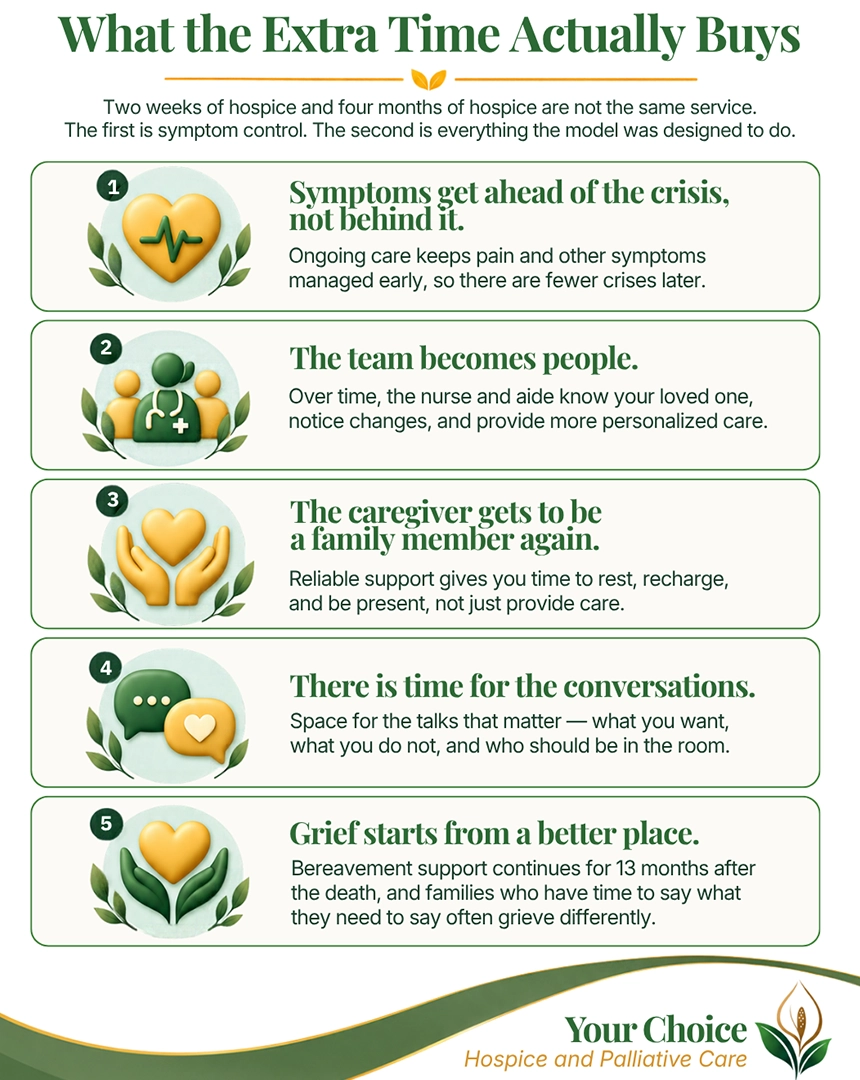
What the extra time actually buys
Two weeks of hospice and four months of hospice are not the same service. The first is symptom control. The second is everything the model was designed to do.
Symptoms get ahead of the crisis, not behind it. Pain managed proactively over months is a different experience from pain chased during a final week.
The team becomes people. A nurse who knows your mother’s face. An aide your husband actually looks forward to seeing. Familiarity is not a nicety here — a person who knows the patient’s baseline catches changes a stranger would miss.
The caregiver gets to be a family member again. This is the one families name most often, and it does not happen in ten days. It takes long enough for someone to believe the help is real.
There is time for the conversations. What matters to you. What you want, and what you do not. Who should be in the room. These need unhurried afternoons, not a hospital corridor.
Grief starts from a better place. Bereavement support runs thirteen months past the death, and families who had time to say what they needed to say grieve differently than families who ran out of it.
What “earlier” actually means
Not months of decline spent waiting. Earlier means starting when the pattern is clear rather than when the crisis arrives.
In practice that is usually one of three moments:
When two or more of the nine signs have been true for a while. Not a bad week — a direction across several months.
When the treatment plan stops changing the trajectory. The appointments continue, but nothing that happens at them alters what the months look like.
When the person says something. I’m tired. I don’t want to go back. Usually said once, quietly, often to whoever is not in charge of decisions. That sentence is the clearest eligibility indicator there is, and it is the one most often set aside.
If you are reading this for someone else
Plenty of people find this page on behalf of a friend, a neighbor, a parent’s partner, or a patient they are worried about at work.
You do not need to be next of kin to ask a question. You cannot enroll someone, and you should not try — but you can call, describe what you are seeing, and find out whether an evaluation makes sense. Then you can hand the family a number and one sentence: it’s free, it’s not a commitment, and they’ll tell you if it’s too early.
Sometimes that sentence is the entire intervention.
Why families wait
The reasons are consistent, and none of them are foolish.
“Calling means giving up.” It does not. Hospice is reversible — you may leave at any time and return later.
“The doctor hasn’t brought it up.” Many clinicians wait for the family to open the door, trying not to sound like they are abandoning you. You are allowed to open it: “Would you be surprised if she were still with us in a year?”
“He’s still having good days.” Good days are a reason to start, not to wait. Good days are what there is more of when symptoms are well managed.
“We’re not ready.” Nobody is. Readiness is not a prerequisite — the evaluation is free, and it is a conversation, not a commitment.
What to do this week
If two or more of the nine signs describe the last few months, ask for an evaluation. Not a decision — an evaluation.
It is free, it happens the same day, and if it is too early, we will tell you so.
The families who called earlier do not describe it as a sad decision. They describe it as the point where the scrambling stopped.
We are here, 24 hours a day. English: 877-732-2344 · Español: 844-447-2992