
When Memory Fades: Hospice Care for Alzheimer’s and Dementia
Dementia caregiving is a marathon, and almost nobody trains for it.
Cancer usually announces its stages. Dementia does not. It takes years, it takes them
gradually, and the grief renews with every stage — which is why caregivers in this journey
report some of the highest rates of burnout and depression of any group.
It is also why so many dementia families never learn that hospice is available to them at all.
There is no scan that comes back with bad news. There is just a slow accumulation of things your mother used to do and does not do anymore.
This is a guide to recognizing that moment, and to what changes when you ask for help.
The hardest question: when is it time?
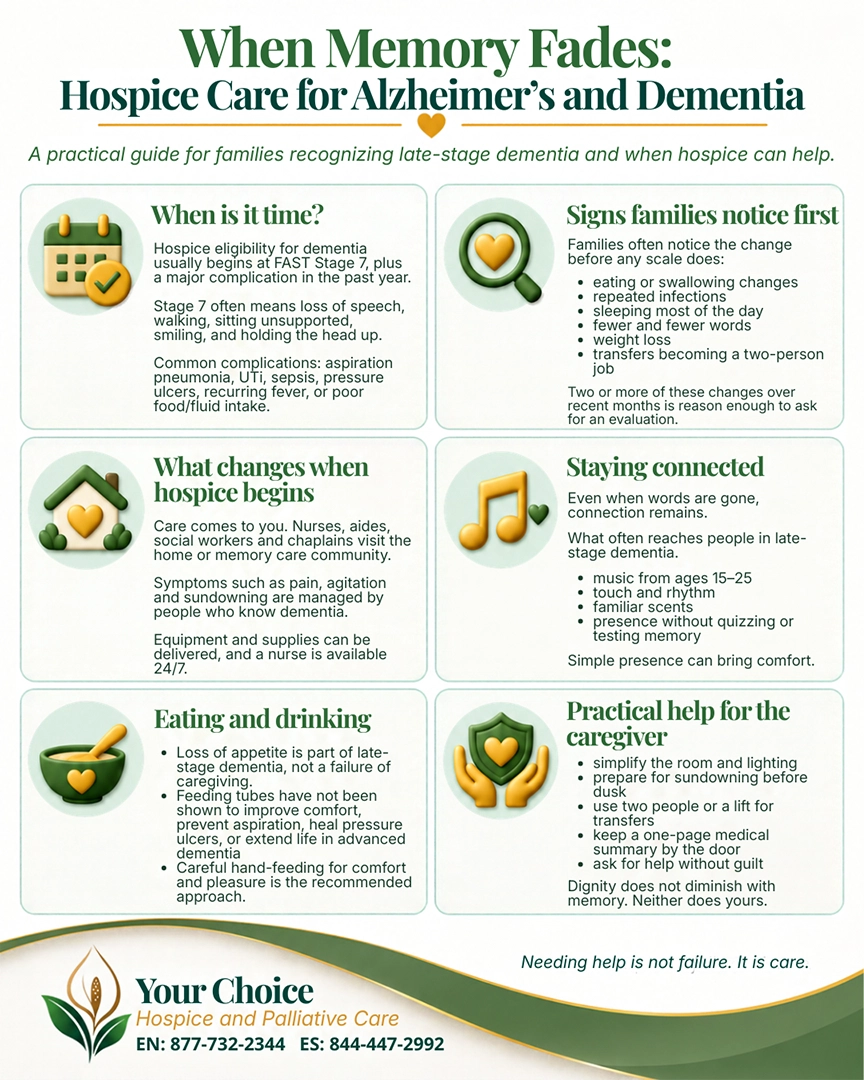
Clinicians use the FAST scale — the Functional Assessment Staging Tool. It maps dementia progression in seven stages, and hospice eligibility generally begins at Stage 7.
In plain language, Stage 7 looks like this. A person has:
- Lost the ability to speak in more than a handful of intelligible words
- Lost the ability to walk without assistance
- Lost the ability to sit up without support
- Lost the ability to smile
- Lost the ability to hold their head up
Eligibility usually requires reaching that functional stage plus at least one significant medical complication in the past year — aspiration pneumonia, a urinary tract infection, sepsis, pressure ulcers at stage 3 or 4, recurring fever after antibiotics, or an inability to maintain enough food and fluid intake.
You are not expected to score this yourself. Bring what you have noticed to an evaluation and let a clinician map it.
The signs families notice before any scale does
Most families sense it months before a chart confirms it. What they describe:
- Eating changes. Turning her head away. Holding food in his mouth without swallowing. Coughing during meals — a warning sign for aspiration.
- Infection after infection. Especially UTIs and pneumonia, each one leaving her a little further back than before.
- Sleep taking over the day. Awake for shorter and shorter windows.
- Words thinning out. From sentences, to phrases, to a few words, to sounds.
- Weight coming off without anyone changing anything.
- Every transfer becomes a two-person job, and one of those people does not exist.
What changes when hospice comes in
The visits come to you. No more loading someone who cannot walk into a car for a fifteen-minute appointment. The nurse, the aide, the social worker and the chaplain come to the home or the memory care community.
Symptoms get managed by people who know dementia. Agitation, sundowning, pain in someone who can no longer say “it hurts” — these are read from behavior, and that is a skill.
The equipment arrives. Hospital bed, pressure-relieving mattress, wheelchair, lift assistance, supplies. Delivered and covered.
The bathing gets done by someone else. For dementia caregivers this is often the single biggest relief. Our aides average three visits a week, and eligible patients receive up to three additional hours of weekly support.
Someone answers at 2 a.m., and it is a nurse who has seen this before.
Hospice serves the memory care community too. If your loved one lives in assisted living or memory care, hospice comes to them there and works alongside the facility staff. Hospice pays for the care; the residence is billed separately.
Staying connected when words are gone
This is the part families ask about most, and the part clinical guides skip.
Memory lives in more than words. It lives in music, in touch, in the smell of coffee at 7 a.m. She may not remember your name. She knows your hands.
What actually reaches people in late-stage dementia:
Music from age 15 to 25. Songs learned in adolescence and early adulthood are encoded most deeply and survive longest. This is why Your Choice staffs a board-certified music therapist — not for entertainment, but because personalized music demonstrably reduces agitation, eases breathing distress, and opens a window of recognition that other approaches cannot.
Touch and rhythm. Hand massage. Brushing hair. A steady voice at a steady pace.
Familiar scents. Coffee. Vanilla. A perfume she wore for thirty years.
Presence without demand. Stop quizzing. Do you know who I am? costs a person something every time. Try instead: Hi Mom, it’s Ana. I’m going to sit with you. Or, if you are the husband of forty years and he no longer recognizes you: It’s me. I’m here. No test. No failure available.
Eating, drinking, and the hardest decision
Almost every dementia family reaches the same crossroads, and almost none are prepared for it: at some point, the person stops eating.
Two things are worth knowing before that moment arrives.
Loss of appetite is part of the illness, not a failure of caregiving. Late-stage dementia damages the brain’s ability to coordinate swallowing and to register hunger. Coaxing, pleading and bargaining do not fix a neurological problem, and they can turn every meal into a battle that costs you both.
Feeding tubes do not help in advanced dementia. This surprises families, and it is one of the clearest findings in the literature: in advanced dementia, tube feeding has not been shown to extend life, prevent aspiration pneumonia, improve pressure ulcers, or improve comfort. Careful hand-feeding of whatever the person will take, for pleasure rather than volume, is the recommended approach.
That does not mean doing nothing. It means offering favorite tastes, small amounts, unhurried. A spoon of ice cream is a legitimate goal.
If a physician raises a feeding tube, it is entirely reasonable to ask: What are we hoping this will change? The hospice team can help you think it through, and the decision is yours either way.
Practical things that make the days easier
Small adjustments, learned from families who found them the hard way:
Simplify the room. Fewer objects, more light in daytime, dimmer in the evening. Clutter reads as chaos to a brain that can no longer sort it.
Watch the late afternoon. Sundowning — agitation that rises as the light drops — is common. Closing blinds before dusk and turning lights on early, rather than after the agitation starts, prevents more episodes than any medication.
Two people for every transfer, or a lift. Caregiver back injuries are one of the most common reasons a family can no longer keep someone at home, and they are preventable. Ask the aide to teach you the technique.
Keep a one-page summary by the door: diagnoses, medications, allergies, code status, the hospice number. Whoever walks in at 3 a.m. will need it.
Say goodbye at the end of each visit as if it stands on its own. Not because anything is imminent, but because it takes the weight off any single day.
For the caregiver
You have been grieving for years already, in pieces, while still doing the laundry. That has a name — anticipatory grief — and it is covered later in this series.
For now, one thing worth hearing: dignity does not diminish with memory. Neither does yours. Needing help is not a verdict on how well you have loved someone. It is what happens when a marathon goes on longer than one person’s legs.
We are here, 24 hours a day.
- English: +1 (877) 732-2344
- Para Español +1 (844) 447-2992
- [email protected]
-
11777 Katy Fwy Suite 270S
Houston, TX 77079