
The biggest barrier to hospice is not clinical. It is not cost, and it is not eligibility.
It is that families do not know what calling sets in motion — so they do not call.
People imagine that dialing the number triggers something irreversible. A form. A decision. A team arriving at the door that afternoon whether they are ready or not.
None of that is what happens. Here is what actually does, step by step.
The first call: about ten minutes
A person answers. Not a phone tree, not a menu, not a callback promise — at the moment that matters, a person.
They will ask you three things: what is going on with your loved one, who their doctors are, and where they live. That is the whole conversation.
You will notice what they do not do. Nobody asks you to make a decision. Nobody asks you to sign anything. Nobody tells you what you should feel about any of it.
If what you want is information, you can stop there. Plenty of people call once, ask their questions, hang up, and call back six weeks later. That is a completely normal use of the phone number.
What to have handy, if you can: the main diagnoses, a rough list of medications, the name of the primary doctor, and the insurance card. If you do not have these, call anyway — we can find most of it.
Confirming coverage: usually the same day
This happens on our side, and it is the step families most expect to be a fight. It usually is not.
We verify the benefit and tell you plainly what it covers and what it does not. For most families in Houston the answer is that hospice is covered in full under the Medicare Hospice Benefit, and Your Choice accepts Traditional Medicare and all Medicare Advantage plans.
If the coverage picture is unusual — no Medicare, a complicated Medicaid situation, a plan we need to check — we will tell you that directly rather than letting you find out later. There are usually options. Ask.
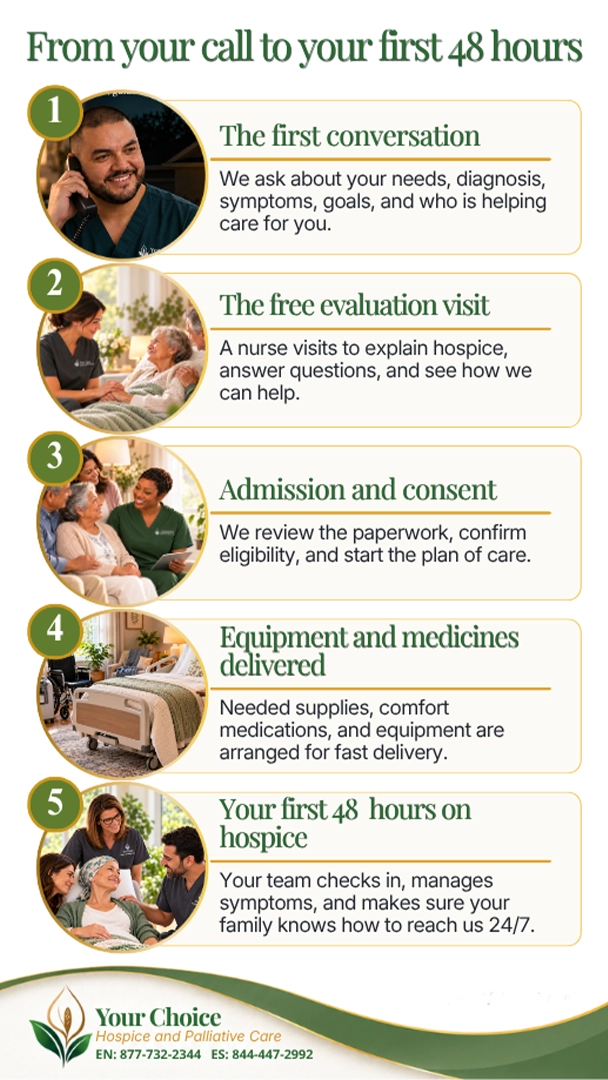
The evaluation: within 24 hours, often the same day
A nurse comes to you. Home, hospital, assisted living, memory care, a nursing facility — wherever your loved one is.
It takes about an hour. It is free whether or not anyone enrolls.
They will examine the patient and review the medical record. They will also look at the things a chart never holds: the stairs, the bathroom, the medication drawer, how the person moves from bed to chair, who is doing the caregiving and how much is left in them.
Then you will get a straight answer. If your loved one qualifies, they will explain exactly what enrolling would change — and what it would not. If it is too early, they will say so, and usually point you toward palliative care, which can start right away and runs alongside ongoing treatment.
Bring your questions in writing. Everyone forgets them otherwise. There is no question too small, and none that will be taken as morbid.
Anyone can be in the room. A spouse or partner, adult children, a stepdaughter, a neighbor who has been doing the driving, a friend on speakerphone from another state. If your loved one has named someone as their medical power of attorney, that person’s authority holds regardless of what the rest of the family assumes.
Admission day: usually that day or the next
Nothing happens until the family says yes. When you do:
Admission takes one to two hours in the home. The nurse writes the plan of care with you — this is a conversation, not a form handed over for signature. Medications get reviewed, and several are often discontinued because they are no longer serving comfort. Many families describe that as the first relief they have felt in weeks.
Equipment is ordered before the nurse leaves. A hospital bed and oxygen typically arrive the same day; the rest follows within a day or two.
You get a phone number that a nurse answers at any hour. They will make you say it back.
The first 48 hours
Within hours: the comfort plan is in place and the first symptom adjustments are made.
Same day or next: medications and equipment arrive. A comfort medication kit is placed in the home, usually in the refrigerator, clearly labeled. It sits unused most of the time — the point is that when something changes at 3 a.m., the medicine is already in the house.
Day one to two: you meet the core team. The RN case manager assigned to you is the same person you will see week after week, not a rotating stranger. The hospice aide is scheduled. Social work calls to start on benefits and paperwork. Chaplaincy reaches out if you want it, and does not if you do not.
Throughout: the 24/7 line is live. No question waits until morning.
By the end of the first week the rhythm is set. Most families describe the same thing, in almost the same words: the house gets quieter, because the scrambling stops.
What if they do not want to talk about it
This stops more families than eligibility does.
You can still call. Nothing about an initial call requires the patient’s participation, and nothing gets set in motion without their consent. Call, ask your questions, and find out what the options are — then you are holding information instead of a fear.
When you do raise it with them, what usually works better than the word itself is a question about what they want: “If things got harder, what would matter most to you?” People who refuse to discuss hospice will often answer that immediately, and their answer is usually a description of exactly what hospice does.
And if they say no, that is their decision to make. A competent adult may decline. What you can do is leave the door open, keep the number, and revisit it in a few weeks — circumstances change, and so do answers.
What if we say yes and then change our minds
You may leave at any time. You sign a revocation form, and you are out. You can come back later, and returning is common.
This is worth repeating because it is the fact that unlocks the decision for most families. Nothing here is a door that locks behind you.
What a nursing visit is actually like
Roughly an hour, once or twice a week — at Your Choice, 80–90% of patients receive at least two.
It is never just vital signs. The nurse assesses comfort head to toe, reviews every medication, watches for the subtle changes a family living with it every day can miss, teaches the caregiver one new skill each visit, and updates the physician and the rest of the team before leaving your driveway.
One hour that quietly holds the whole week together.
You are never bothering us
“I didn’t want to bother anyone.”
It is the most common thing caregivers say, and one of the most costly. That hesitation is what turns a manageable change at 9 p.m. into an ambulance at 2 a.m.
Call for any of it: new or worsening pain, breathlessness, restlessness, a medication you are unsure about, a change you do not understand, or simply needing reassurance in the middle of the night.
A phone call to a nurse prevents a frightening ambulance ride, and keeps the patient comfortable and at home — which is almost always what the family wanted in the first place.
There is no such thing as bothering us. That is what the number is for.
Same-day evaluations, seven days a week.
English: 877-732-2344 · Español: 844-447-2992