
“We’re not ready to give up.”
We hear it in almost every first conversation — from a daughter, a son, a husband, a wife, a partner — usually with their voice catching a little. And we honor it — because underneath that sentence is love, and a refusal to stop fighting for someone.
So let us answer it directly. Hospice is not surrender. It is choosing a different fight.
Not the fight against a disease that is no longer responding. The fight for comfort over procedures. For days that feel like living. For your loved one’s own definition of a good day.
Nothing about comfort care is passive. It is care at its most intentional.
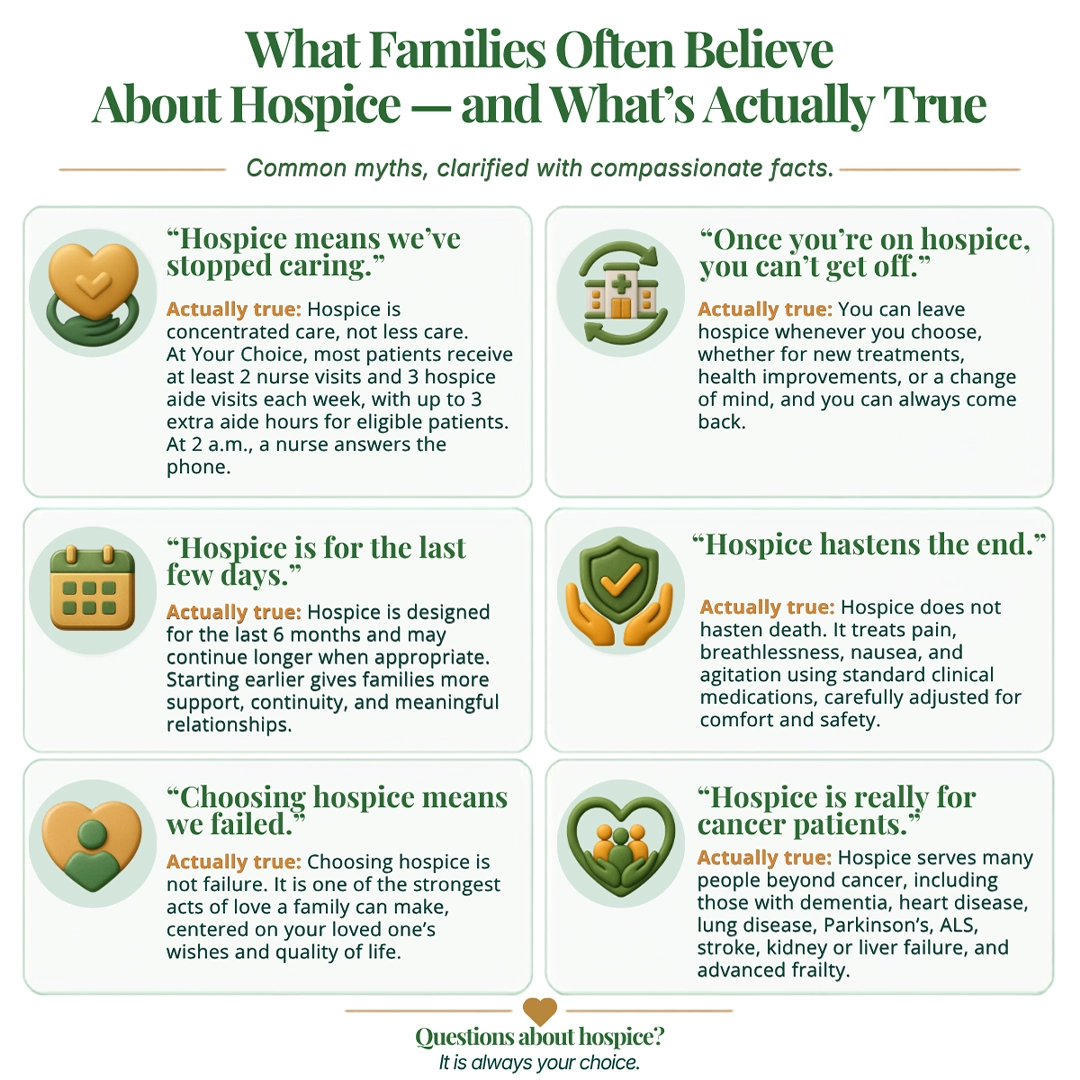
Six things families believe, and what is actually true
“Hospice means we’ve stopped caring for them.”
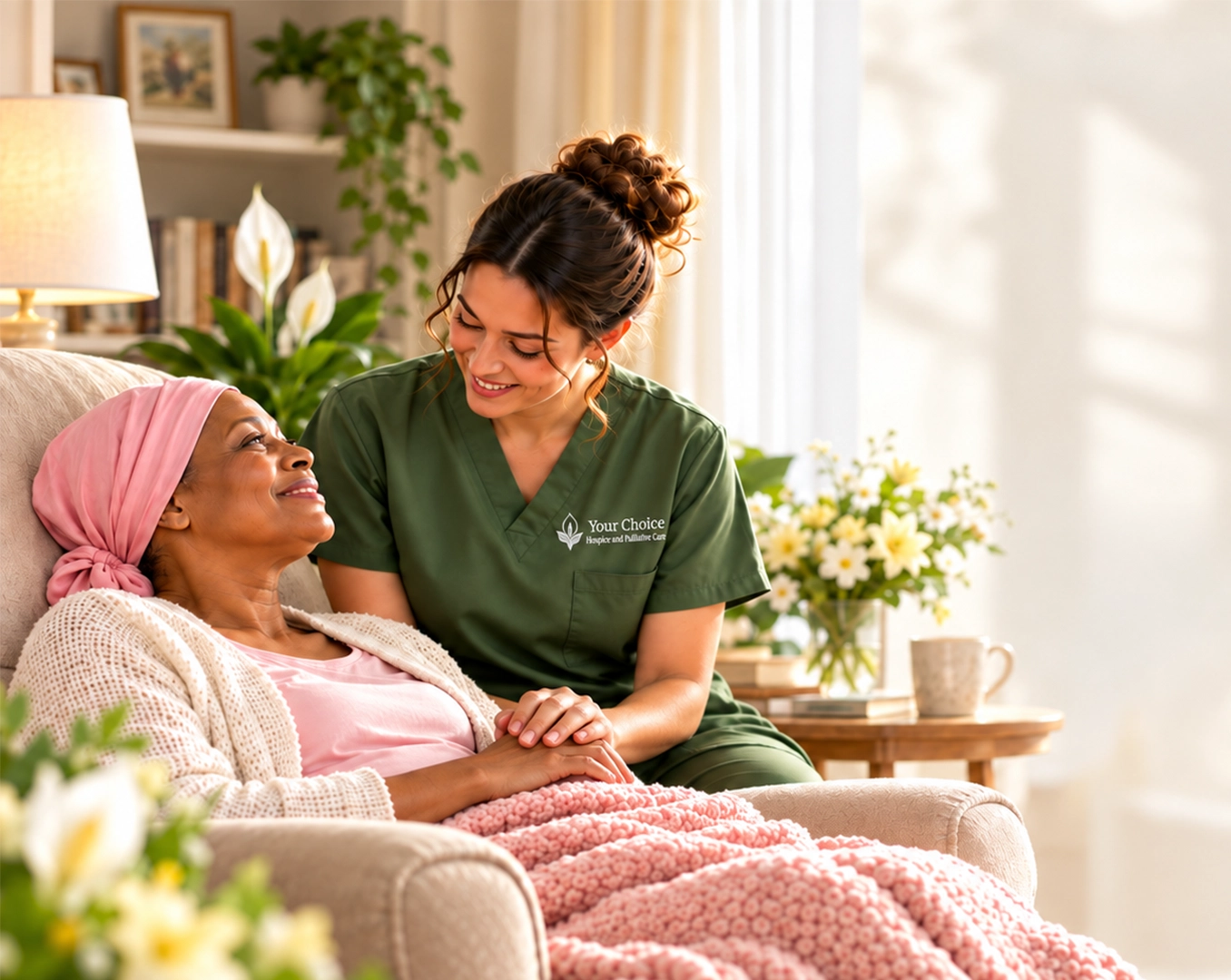
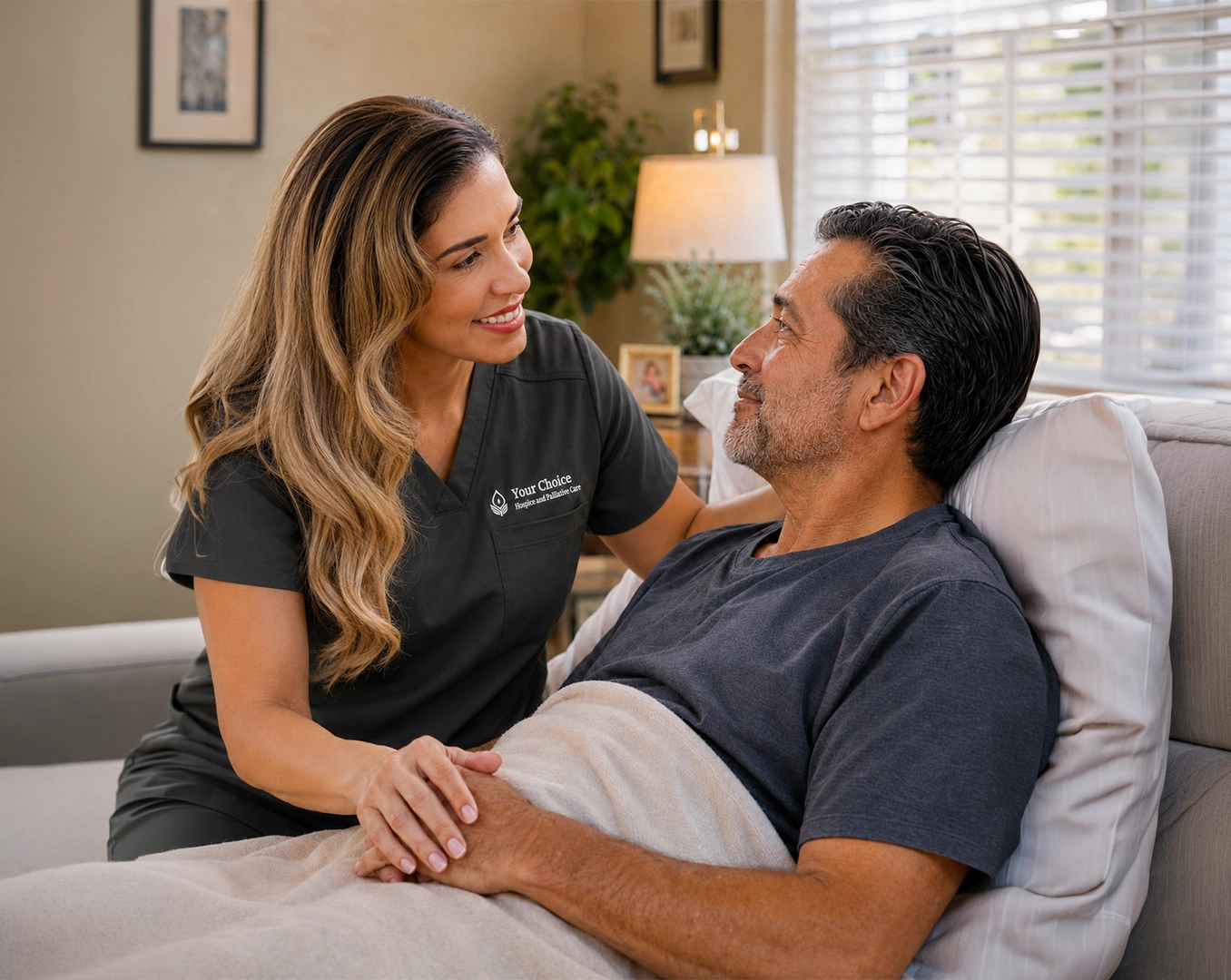
The opposite happens. Hospice is care, concentrated — more visits, not fewer. At Your Choice, most patients receive at least two nurse visits and three hospice aide visits every week, and eligible patients can receive up to three additional hours of weekly aide support. Someone answers the phone at 2 a.m., and it is a nurse, not an answering service.
Compare that to the weeks before, when a family was driving to appointments and waiting three days for a callback.
“Once you’re on hospice, you can’t get off.”
You may leave hospice at any time. If a new treatment becomes available, if your loved one’s condition improves, if the family simply changes its mind — you sign a form, and you are out. You can come back later.
It is always your choice. That is not a slogan; it is the name of the company, and it is how the benefit is written.
“Hospice is for the last few days.”
It is designed for the last six months, and people routinely stay longer when their condition supports it. Certification is simply renewed.
Families who come on with weeks left get crisis management. Families who come on with months left get relationships — a nurse who knows their mother’s face, an aide their husband actually looks forward to seeing. The care is the same. What changes is how much of it they get to have.
“Hospice hastens the end.”
It does not. Hospice treats symptoms — pain, breathlessness, nausea, agitation — using the same medications, at the same clinical doses, that a hospital would use. What changes is how carefully they are titrated and how quickly someone responds when something is wrong.
Several studies have found that patients receiving comfort-focused care lived as long as, and in some cases longer than, those who continued aggressive treatment. Suffering is not what keeps people here.
“Choosing hospice means we failed.”
Choosing hospice is one of the most powerful acts of love a family can make. It requires you to set aside what you want — more time, one more treatment, one more chance — and ask instead what they want.
That is not failure. That is the hardest thing a family ever does well.
“Hospice is really for cancer patients.”
Cancer is a minority of hospice admissions nationally. The largest diagnosis groups are dementia, heart disease and lung disease. We also serve people with Parkinson’s, ALS, kidney and liver failure, stroke, and general decline in advanced age — where there is no single dramatic diagnosis, just a body that is finishing.
If you have been told your parent “doesn’t have anything terminal,” it is still worth asking. Frailty and decline qualify.
When the family does not agree
This is the part nobody writes about, and it happens in most families.
One person is ready. Another is certain that choosing comfort means abandoning their mother. A third lives out of state, has not seen the last six months up close, and is the loudest voice on the call.
It is not always siblings. It can be a spouse and an adult child who see it differently, a partner whom the rest of the family has never fully accepted, a stepdaughter doing all the caregiving with none of the authority, or an old friend who knows what this person actually wants better than any relative does.
A few things that help:
Move the question off yourselves. The question is not what can we accept? It is what would they choose, if they could tell us right now? Most families already know the answer. It is easier to agree on theirs than on your own.
Find out who actually has the authority. If there is a medical power of attorney, that person decides — and it may not be the eldest, the loudest, or the one the family assumes. If a patient has named a partner rather than a relative, that naming holds. Our social workers deal with this every week and can walk you through it without anyone having to argue.
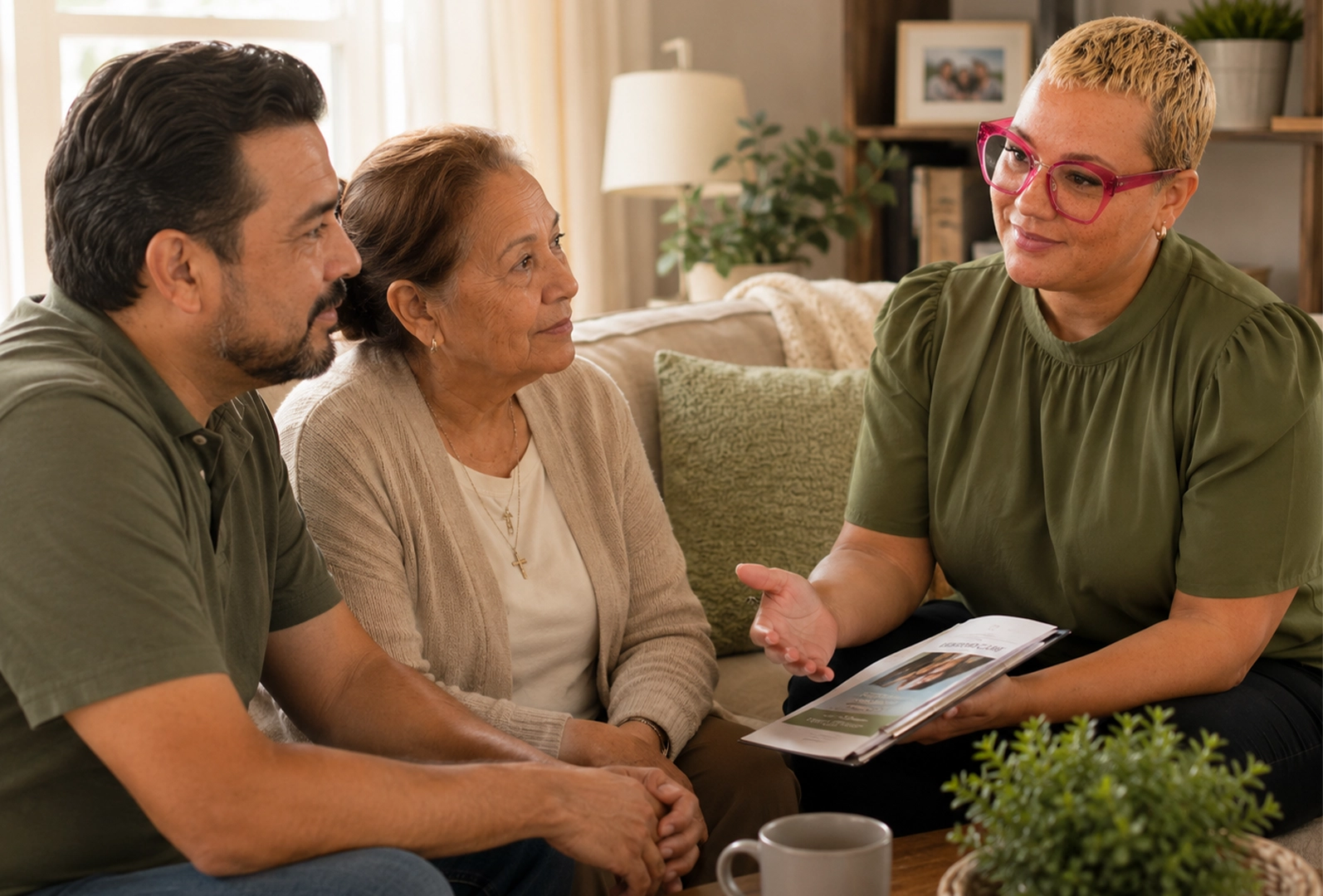
Let the evaluation be the tiebreaker. It is free, it is not a commitment, and it puts a clinician in the room instead of leaving everyone to argue from opposite memories. Many families who could not agree in July agree in the hour after the nurse leaves.
Say the reversible part out loud. Whoever is fighting hardest is usually fighting a door they believe locks behind them. It does not. Tell them.
Let the social worker in. Family conflict at this stage is not a side issue — it is a clinical problem that affects the patient, and it is squarely part of what a hospice social worker is trained to do.
What “comfort” actually means
It is not a softer word for doing less. In practice, comfort care means:
- Pain and breathlessness managed around the clock, with medication adjusted as often as needed
- A hospital bed, oxygen, wheelchair and supplies delivered to the home and covered
- Bathing and grooming done by someone trained to do it without stripping anyone’s dignity
- A social worker handling the benefits, the paperwork, and the family conversations nobody wants to start
- A chaplain for whatever a person believes, or does not
- Music therapy that reaches a person with dementia when words no longer do
- Thirteen months of bereavement support for the family afterward
That is not less care. That is more care, aimed at a different target.
The question underneath the question
When a family says we’re not ready to give up, what they are usually asking is: if we choose this, does it mean we stopped loving them enough to fight?
No. It means the fight changed shape.
You are still fighting — for a night without pain, for a morning clear enough to talk, for the chance to be a daughter, a son, a husband, a wife again instead of a full-time nurse.
We are here, 24 hours a day. Free consultation, in your home or by phone.
- +1 (877) 732-2344
- Para Español +1 (844) 447-2992
- [email protected]
-
11777 Katy Fwy Suite 270S
Houston, TX 77079