

This is the most misunderstood distinction in healthcare, and families pay for the confusion in months they do not get back.
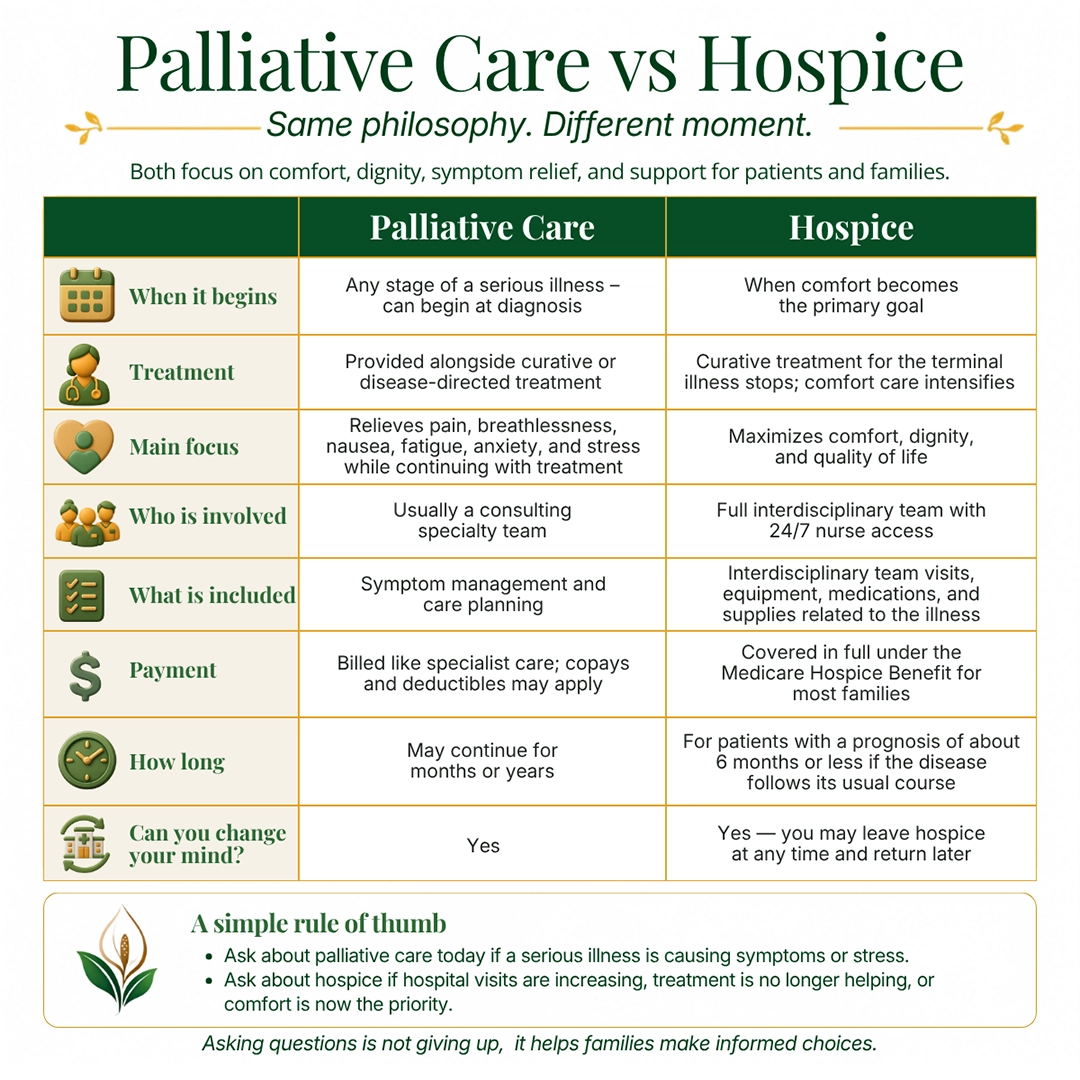
Here is the short version. Palliative care can start the day you are diagnosed, alongside treatment meant to cure or control the illness. Hospice is palliative care at its most intensive, chosen when comfort has become the primary goal.
Same philosophy. Same specialty. Different moments.
Palliative care: comfort, alongside treatment
Palliative care is specialized medical care for people living with a serious illness — heart failure, advanced COPD, kidney disease, ALS, cancer, and many others. Its job is to treat the symptoms and the stress of the illness: pain, breathlessness, nausea, fatigue, anxiety, sleeplessness.
The part most families miss: you can receive it while you are still pursuing aggressive treatment. Chemotherapy and palliative care together. Dialysis and palliative care together. It is not either-or, and it is not a signal that anyone has stopped fighting.
Research has consistently found that people who receive palliative care early report better quality of life and fewer symptoms — and in several studies, they lived longer than those who did not.
A palliative team can be involved for years.
Hospice: comfort, as the goal
Hospice begins when the illness is no longer responding to curative treatment, and when the person decides that how they feel each day matters more than how long the illness can be held back.
Formally, that means two physicians certifying a prognosis of six months or less if the disease follows its usual course. Practically, it means the whole plan reorganizes around comfort, dignity, and time that feels like living.
Everything intensifies. Visits increase. Equipment and medications related to the illness are delivered and covered. A nurse is reachable at any hour. The family gets support too — including thirteen months of bereavement care after their person dies.
The differences that actually matter
Timing. Palliative care: any stage, from diagnosis onward. Hospice: when comfort becomes the primary goal.
Treatment. Palliative care runs alongside curative treatment. Hospice replaces curative treatment for the terminal illness — while treating everything else, including comfort, aggressively.
Who pays. Palliative care is billed like other specialist visits, so copays and deductibles apply. Hospice is covered in full under the Medicare Hospice Benefit for most families.
What comes with it. Palliative care is usually a consulting team. Hospice brings a full interdisciplinary team to the home, plus equipment, medications, and supplies.
Reversibility. Both are reversible. You may leave hospice at any time and return later. It is always your choice.
Three situations, three answers
A 71-year-old with advanced COPD, still on inhalers and steroids, hospitalized twice this year, breathless walking to the mailbox. Palliative care, today. A palliative team can manage the breathlessness and anxiety while his pulmonologist continues treating the disease. Nothing stops. Something gets added.
A 84-year-old with heart failure who has been in the ER three times in four months, whose ejection fraction keeps dropping despite optimal medication, and who told her daughter last week that she does not want to go back to the hospital again. Time to ask about hospice. The treatment is no longer changing the trajectory, the hospital trips are costing her more than they return, and — most importantly — she has said what she wants.
A 66-year-old halfway through chemotherapy for pancreatic cancer, exhausted, nauseated, in pain between cycles. Palliative care alongside the chemotherapy. This is exactly the situation the research was built on: symptom management during treatment improves quality of life, and patients tolerate their treatment better for it.
What to ask your doctor
Doctors rarely raise either option first. Many wait for the family to open the door — not from indifference, but because they are trying not to sound like they are giving up on you.
So open it. These questions do that without forcing anything:
- “Would palliative care be appropriate for us now, alongside what we’re already doing?”
- “If you had to guess, are we talking about years, months, or weeks?” (Ask for the honest range. You are allowed to.)
- “If his condition doesn’t respond to this next treatment, what would you recommend then?”
- “Would you be surprised if she were still with us in a year?” (This is a question clinicians ask each other, and the answer tells you a great deal.)
- “Can you write an order for a hospice evaluation, so we can just hear what it would involve?”
None of these commits you to anything. All of them get you a straighter answer than “how is she doing?” ever will.
"Which one do we need?”
You do not have to answer that yourself, and you should not have to.
A reasonable rule of thumb: if your loved one has a serious illness and is uncomfortable, ask about palliative care today. If the hospital visits are stacking up, if treatment is causing more suffering than it relieves, or if they have started saying they do not want to go back — it is time to ask about hospice.
The evaluation is free, and it is not a commitment. If it is too early, we will tell you, and point you toward palliative support instead. That is not us losing a patient. That is us doing the job right.
The one thing families regret
Almost nobody tells us they called too soon.
What we hear, again and again, is the opposite — that they waited, because they thought asking meant giving up, and by the time they called, the time they had left was measured in days instead of months.
Asking a question is not a decision. It is just a question.
We are here, 24 hours a day. Free consultation, in your home or by phone.
- +1 (877) 732-2344
- Para Español +1 (844) 447-2992
- [email protected]
-
11777 Katy Fwy Suite 270S
Houston, TX 77079