

Ask a family what they were most afraid of, and it is almost never the end itself. It is the idea of watching someone they love be in pain and not being able to do anything about it.
That fear is the reason this article exists. Pain should never be the last thing a person feels — and with a hospice team, it does not have to be.
What happens when you call at 2 a.m.
A real voice answers. A nurse — not an answering service that takes a message and promises a callback in the morning.
They ask what changed. Restlessness? Grimacing when you turn her? Breathing that sounds like work? Then they do one of three things: talk you through a dose adjustment from the comfort kit already in your home, call the on-call physician to authorize a change, or come to the house.
Nobody tells you to wait until morning. Nobody tells you to call 911 and start the whole hospital cycle over again, unless that is genuinely what is needed.
This is the difference families feel most, and it is the reason “24/7” is written into our promise rather than our marketing. Comfort cannot wait until morning.
The comfort kit, and why it is already in your house
Within the first day or two of admission, a small kit of comfort medications is placed in the home — typically in the refrigerator, clearly labeled.
It usually contains medication for pain and breathlessness, for nausea, for anxiety and restlessness, for excess secretions, and for fever.
It sits there unused, most of the time. The point is that when something changes at 3 a.m., the medicine is already in the house. You are not driving to a 24-hour pharmacy while someone struggles.
Nothing in that kit is given without a nurse or physician directing it. It is not a decision anyone leaves to a frightened family at 3 a.m.
How comfort medications actually work
Two fears come up in nearly every family meeting, and both deserve straight answers.
“Will morphine hasten the end?”
Used properly — started low, increased gradually, matched to the symptom — opioids relieve pain and breathlessness without shortening life. This is well established in palliative medicine. What clinicians actually observe is the opposite pattern: a person whose pain is finally controlled sleeps, eats a little, talks to their family, and is more present, not less.
Untreated pain is what exhausts a body.
“Will they become addicted?”
Addiction is compulsive use despite harm. Someone taking a prescribed opioid for real, measured pain, at a dose a nurse is adjusting, is not on that path. Physical tolerance is not addiction, and it is managed routinely.
The greater risk in hospice, by a wide margin, is undertreatment.
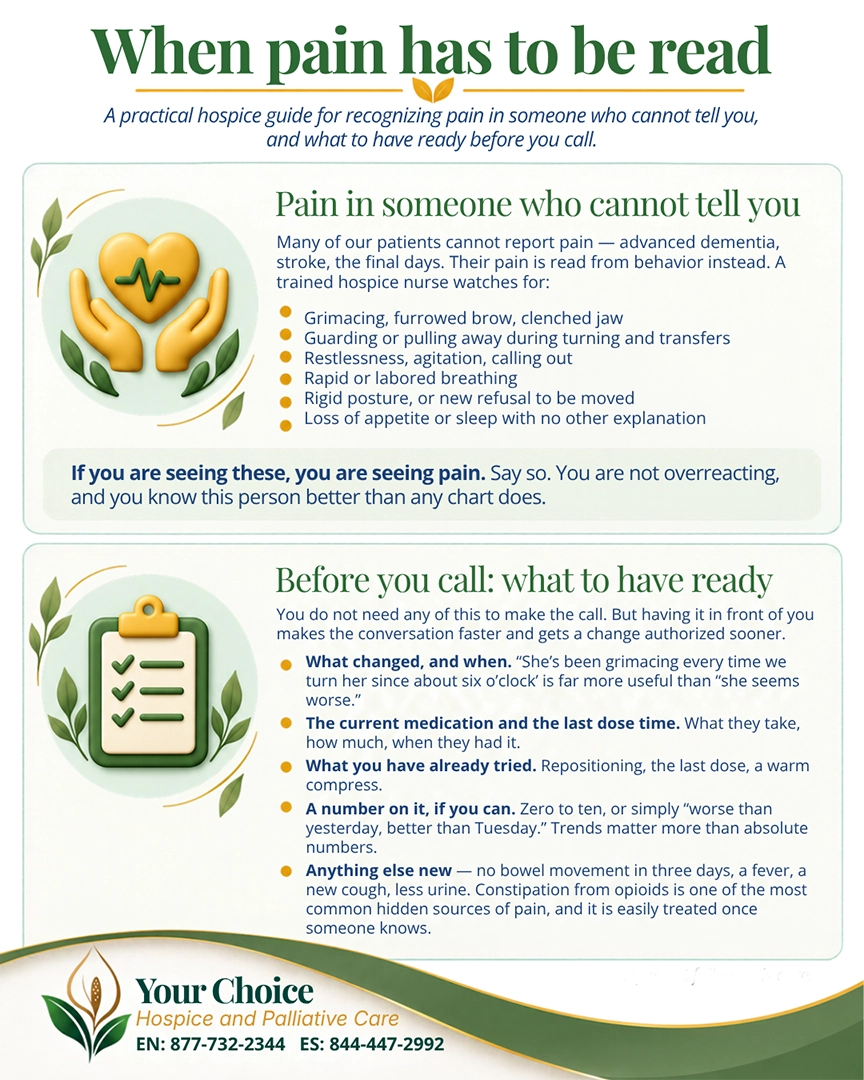
Pain in someone who cannot tell you
Many of our patients cannot report pain — advanced dementia, stroke, the final days. Their pain is read from behavior instead. A trained hospice nurse watches for:
- Grimacing, furrowed brow, clenched jaw
- Guarding or pulling away during turning and transfers
- Restlessness, agitation, calling out
- Rapid or labored breathing
- Rigid posture, or new refusal to be moved
- Loss of appetite or sleep with no other explanation
If you are seeing these, you are seeing pain. Say so. You are not overreacting, and you know this person better than any chart does.
Pain in someone who cannot tell you
Pain has physical, emotional and spiritual dimensions, and a team treats all three:
Positioning and pressure relief — specialty mattresses, repositioning schedules, small adjustments that prevent an entire category of pain.
Music therapy — live, patient-preferred music reduces perceived pain intensity without additional medication, and can synchronize breathing to ease dyspnea. Our board-certified music therapist is part of the clinical team, not an extra.
Presence — anxiety amplifies pain. A chaplain sitting quietly in the room, or an aide who is unhurried, changes what a person’s body is doing.
Caregiver education — most middle-of-the-night crises are prevented by teaching a family what to expect and what to do first.
Before you call: what to have ready
You do not need any of this to make the call. But having it in front of you makes the conversation faster and gets a change authorized sooner.
- What changed, and when. “She’s been grimacing every time we turn her since about six o’clock” is far more useful than “she seems worse.”
- The current medication and the last dose time. What they take, how much, when they last had it.
- What you have already tried. Repositioning, the last dose, a warm compress.
- A number on it, if you can. Zero to ten, or simply “worse than yesterday, better than Tuesday.” Trends matter more than absolute numbers.
- Anything else new — no bowel movement in three days, a fever, a new cough, less urine. Constipation from opioids is one of the most common hidden sources of pain, and it is easily treated once someone knows.
The first day of better pain control
When a dose is finally right, families describe a fairly consistent sequence.
The first few hours: sleep. Often a lot of it. This alarms families, who worry the medication was too strong. Usually it is not the medication — it is exhaustion. A body that has been fighting pain for days finally stops fighting and rests.
The next day: more presence, not less. This is the part worth waiting for. Someone whose pain is controlled talks more, eats a little, recognizes people, tolerates being moved. The medication did not take them away; the pain had.
Then, adjustment. Doses get refined over the first week — most patients need at least one change. Grogginess in the first day or two often settles as the body adapts. If it does not, say so; the dose or the drug can change. Persistent sedation is not something you have to accept as the price of comfort.
Tell the nurse what you are seeing at every visit. You are the one in the room. The chart is not.
What we hold ourselves to
No family should watch someone they love suffer because they could not reach anyone at 2 a.m.
That is the standard. It is why a nurse answers the phone at any hour, why the comfort kit is in your refrigerator before you need it, and why most of our patients receive at least two nurse visits every week rather than the minimum.
If pain is not controlled where you are right now, that is not something to wait out. Call, and let us talk it through.
- English: +1 (877) 732-2344
- Para Español +1 (844) 447-2992
- [email protected]
-
11777 Katy Fwy Suite 270S
Houston, TX 77079