

M
ost families do not go looking for this page. They arrive at it after a conversation that did not go the way they expected: a doctor who paused before answering, a hospital stay that felt like the third one this year, a parent who said quietly that they did not want to go back.
If that is roughly where you are, take a breath. You are not late. You are not making a decision you cannot undo. And you are not giving anything up by reading this.
This guide explains what hospice care actually is, who qualifies for it, what it costs in Houston, what happens in the first week, and how to start when you are ready. Plain language, no pressure.
What hospice care actually is
Hospice is a kind of care, not a place.
For the great majority of the families we serve in Houston, hospice happens at home, in the house someone has lived in for forty years, or in their room at an assisted living community, or in a daughter’s spare bedroom. Wherever a person calls home is where the care goes.
What changes when someone comes onto hospice is not the location. It is the goal. Instead of organizing care around slowing an illness, the whole team organizes it around one question: what would make today good for this person? Sometimes the answer is better pain control. Sometimes it is sleeping through the night. Sometimes it is being awake enough at 4 p.m. to watch a grandchild’s soccer video.
Two things follow from that shift, and they surprise most families:
The care gets more intensive, not less. A team comes to the home on a schedule: nursing, a hospice aide, social work, chaplaincy, and at Your Choice a board-certified music therapist. Most of our patients receive at least two nurse visits and three aide visits every week. Someone answers the phone at 2 a.m., and it is a nurse, not an answering service.
Everything the patient needs comes with it. The hospital bed, the oxygen concentrator, the wheelchair, the medications related to the illness, the supplies, all delivered, all covered.
Hospice is not “giving up”
This is the sentence we hear most often (from a daughter, a son, a husband, a wife, a partner), usually with their voice catching: We’re not ready to give up.
We honor that, every time. And we answer it the same way: hospice is not surrender. It is choosing a different fight: for comfort over procedures, for days that feel like living, for your loved one’s own definition of a good day.
Nothing about comfort care is passive. It is care at its most intentional.
It is also reversible. This is the single most important fact in this guide and the one families almost never know: you may leave hospice at any time. If a treatment becomes available, if someone’s condition improves, if the family simply changes its mind, you sign a form and you are out. You can come back later. It is always your choice.
Who qualifies
The formal requirement is that two physicians certify a prognosis of six months or less if the illness follows its expected course. That phrasing matters. It is a clinical estimate, not a countdown. And people routinely stay on hospice care longer than six months when their condition supports it. Certification is simply renewed.
Hospice serves far more than cancer. In Houston we care for people with advanced heart failure, COPD and other lung disease, Alzheimer’s and other dementias, Parkinson’s, ALS, kidney and liver failure, stroke, and general decline in old age.
You do not need to figure out eligibility yourself. That is what the evaluation is for, and it is free. If it turns out to be too early, we will say so, and point you toward the right support instead.
The signs families notice first
Families usually sense it before a chart does. The most common patterns we see:
- More frequent falls, or a clear loss of strength and balance
- Unintended weight loss, or a fading interest in food and drink
- Recurring infections — UTIs, pneumonia, skin infections
- Sleeping much more during the day, unusual fatigue
- Needing more help with bathing, dressing, transferring, eating
- Worsening confusion, agitation, or loss of language in dementia
- New or increasing oxygen needs, more shortness of breath
- Several hospital or ER trips in the last six months
- A caregiver who is running out of room to carry it
If two or more of these describe the last few months, it is reasonable to ask for an evaluation. Asking costs nothing and commits you to nothing. Week 06 of this series covers these nine signs in depth.
What it costs
For most families in Houston: nothing.
The Medicare Hospice Benefit covers the care team’s visits, the medications related to the terminal illness, durable medical equipment, medical supplies, therapy services, short-term inpatient and respite care, and thirteen months of bereavement support for the family after the patient dies. Medicaid and most private insurance plans mirror this structure. Your Choice accepts Traditional Medicare and all Medicare Advantage plans.
The most common out-of-pocket costs, where they exist at all, are small: a possible copay of up to $5 per prescription for comfort medications, and up to 5% of the cost of inpatient respite care.
What hospice does not cover is treatment aimed at curing the terminal illness, and care from providers your hospice team has not arranged. Room and board at a nursing facility is also separate: hospice pays for the care, not the residence.

Where hospice care happens
Because hospice is a service rather than a building, it follows the patient:
At home. The most common setting by far, and the one most people say they want. The team comes to the house; the family remains the primary day-to-day caregiver, with the team teaching, supplying and supporting them.
In assisted living or memory care. Hospice comes to the resident and works alongside the community’s staff. This does not replace the facility’s care. It adds a layer on top of it. Hospice pays for the care; the residence bills room and board separately, as it always did.
In a nursing facility. Same arrangement. The hospice team and the facility nurses coordinate a single plan rather than running two.
In an inpatient setting, briefly. When symptoms cannot be controlled at home (pain that will not settle, a breathing crisis), a patient can move to an inpatient unit until things stabilize, then return home. This is called general inpatient care, and it is covered.
Respite care. Up to five consecutive days in a facility so the family caregiver can sleep, travel, or attend to their own health. Also covered, with a small possible coinsurance.
What the first 48 hours actually look like
Families brace for this and are usually surprised by how ordinary it is.
Day one. The admission nurse spends one to two hours in the home, reviewing medications (often discontinuing several that are no longer serving comfort, which many families experience as an immediate relief) and writing the plan of care with you. Before leaving, they give you the after-hours number and make you say it back.
Equipment is ordered before they go. A hospital bed and oxygen typically arrive the same day; other items follow within a day or two.
Day two. The comfort medication kit is delivered and placed in the refrigerator. Your assigned RN case manager visits. This is the nurse you will see week after week, not a rotating stranger. The hospice aide is scheduled. The social worker calls to introduce herself and start on benefits and paperwork.
By the end of week one you will have met your core team, and the rhythm of visits will be set. Most families describe the same thing: the house gets quieter, because the scramble stops.
Questions worth asking any hospice you consider
Not all hospices operate the same way, and the differences are measurable. Ask any provider you are considering:
- How many nurse visits per week will we actually get? (Ask for their average, not their minimum.)
- How many hospice aide visits, and for how long each?
- Who answers the phone at 2 a.m. — a nurse, or an answering service?
- How quickly can you do the evaluation? Same day?
- Do you have a chaplain and a social worker on staff, or contracted?
- Do you offer music therapy or other comfort therapies?
- Are you accredited? By whom?
- What happens if my loved one lives in a facility?
- Do you have Spanish-speaking staff, or do you use a phone interpreter?
For reference: at Your Choice, 80–90% of patients receive at least two nurse visits and three hospice aide visits per week, eligible patients receive up to three additional hours of weekly aide support, and our aides are paid $4–$6 above Houston averages — which is how we keep the same faces coming back to the same families.
What happens when you call
Families brace for this and are usually surprised by how ordinary it is.
Day one. The admission nurse spends one to two hours in the home, reviewing medications (often discontinuing several that are no longer serving comfort, which many families experience as an immediate relief) and writing the plan of care with you. Before leaving, they give you the after-hours number and make you say it back.
Equipment is ordered before they go. A hospital bed and oxygen typically arrive the same day; other items follow within a day or two.
Day two. The comfort medication kit is delivered and placed in the refrigerator. Your assigned RN case manager visits. This is the nurse you will see week after week, not a rotating stranger. The hospice aide is scheduled. The social worker calls to introduce herself and start on benefits and paperwork.
By the end of week one you will have met your core team, and the rhythm of visits will be set. Most families describe the same thing: the house gets quieter, because the scramble stops.
The team that comes with it
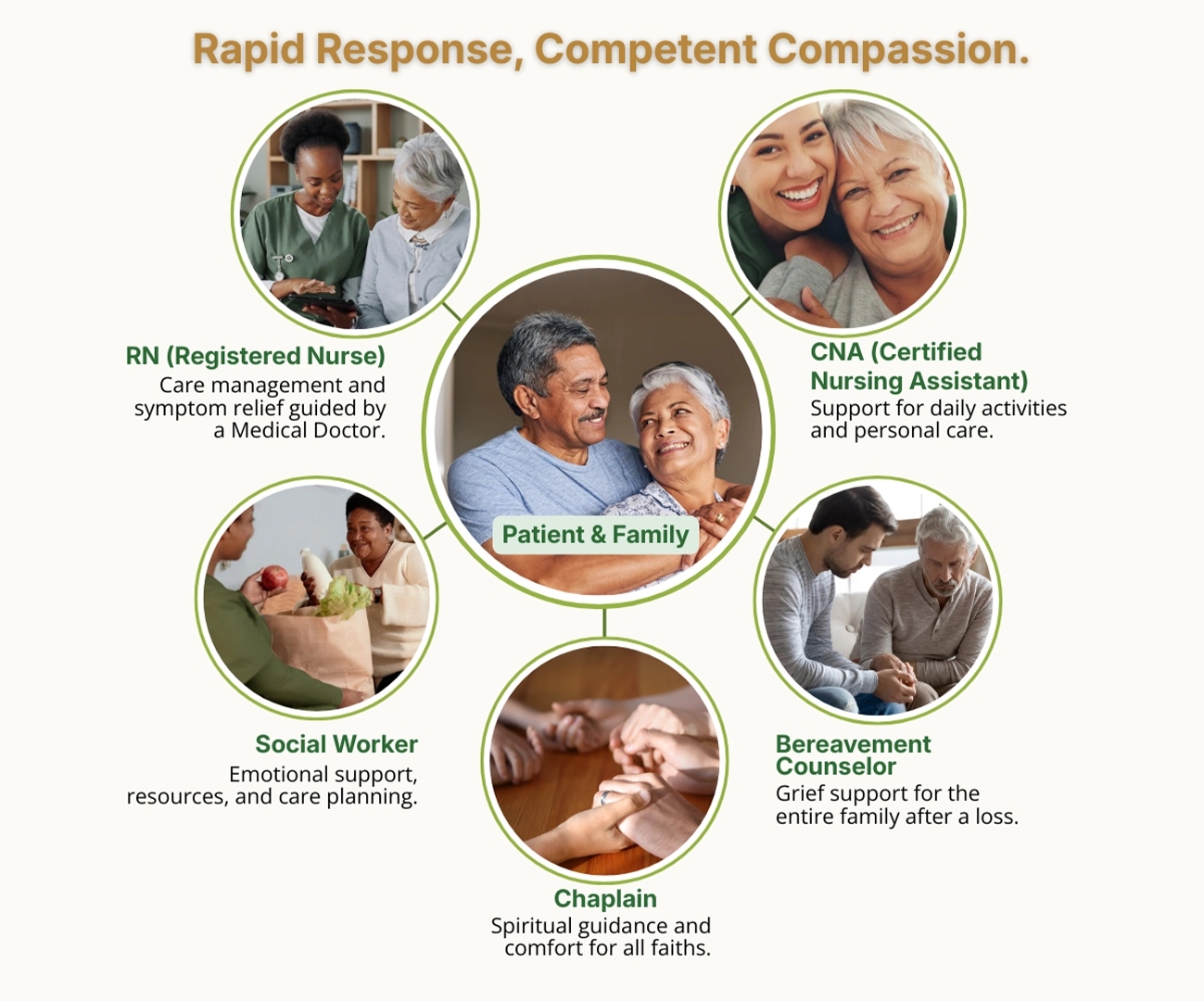
Your loved one does not just get a nurse. They get a team:
A note on the word family: we use it the way you do. The person doing the caregiving might be a spouse or a partner, a son or a daughter, a grandchild, a sibling, a neighbor of thirty years, a best friend, or a chosen family that no paperwork has ever acknowledged. Whoever your loved one names is who we work with, and who we support afterward.
And if there is no one (if the person we are caring for lives alone, or their people are far away), say so on the first call. That changes what we plan for, and it is a situation we are built to handle.
RN Case Manager: the captain of the care plan. Manages symptoms, adjusts medications, and is your main point of contact.
Hospice Aide: bathing, grooming, dressing, and the daily dignity work families find hardest to do for a parent.
Medical Social Worker: benefits, paperwork, family conflict, funeral planning, community resources you did not know existed.
Chaplain: spiritual support for every faith, and for no faith at all. Sometimes that is prayer. Sometimes it is sitting in the silence with you.
Board-Certified Music Therapist: a clinical service, not entertainment. Music therapy is used to reduce perceived pain, ease anxiety and breathing distress, reach patients with dementia when words no longer work, and create legacy recordings families keep.
Hospice Physician, Bereavement Counselor, and trained volunteers complete the circle.
What this looks like in Houston
Your Choice is locally owned, veteran-led, women-owned and minority-owned, CHAP-accredited and CHAP Age-Friendly certified. We serve the greater Houston metro, and we serve it in English and in Spanish: not translated on request, but staffed.
That last part is not a marketing line. When a family is making the hardest decision of their lives, being able to make it in their own language, with their own traditions respected, is part of the medicine.
When to make the call
The most common thing families tell us afterward is some version of I wish we had called sooner. Not because anything went wrong, but because the weeks they did have were better than the weeks before, and they realize they could have had more of them.
You do not need a referral to ask. You do not need your doctor’s permission to have a conversation. And you are not committing to anything by picking up the phone.
We are here, 24 hours a day. Free consultation, in your home or by phone.
- +1 (877) 732-2344
- Para Español +1 (844) 447-2992
- [email protected]
-
11777 Katy Fwy Suite 270S
Houston, TX 77079