Cancer is the one illness where families expect to be told when the treatment stops working.
Often they are not. The scan gets described as “mixed.” A next-line option is mentioned, with a response rate nobody quite states out loud. The appointments continue, and somewhere in the middle of them, the person getting treated is sleeping more, eating less, and spending most of the good hours recovering from the last cycle.
This article is for the space between those two things: still in treatment, no longer sure it is helping.
Comfort care does not wait for treatment to end
The most useful thing to know is that comfort-focused care is not a single door at the end of a hallway. It comes in two forms, and the first one starts now.
Alongside treatment. Palliative care runs in parallel with chemotherapy, immunotherapy, radiation — anything. Its job is the pain, the nausea, the fatigue, the neuropathy, the anxiety, the sleeplessness. You do not stop anything to get it.
This is worth taking seriously because the evidence is unusually strong. In people with advanced cancer, early palliative care alongside standard oncology treatment has been associated with better quality of life, fewer depressive symptoms, less aggressive care at the end of life — and in some studies, longer survival. Managing symptoms is not a consolation prize. It helps people tolerate the treatment itself.
If your oncologist has not raised it, you can: “Would a palliative care referral make sense now, alongside what we’re already doing?”
When comfort becomes the goal. Hospice begins when disease-directed treatment is no longer working or is costing more than it returns, and when the person decides that how they feel each day matters more than what the next scan might show.
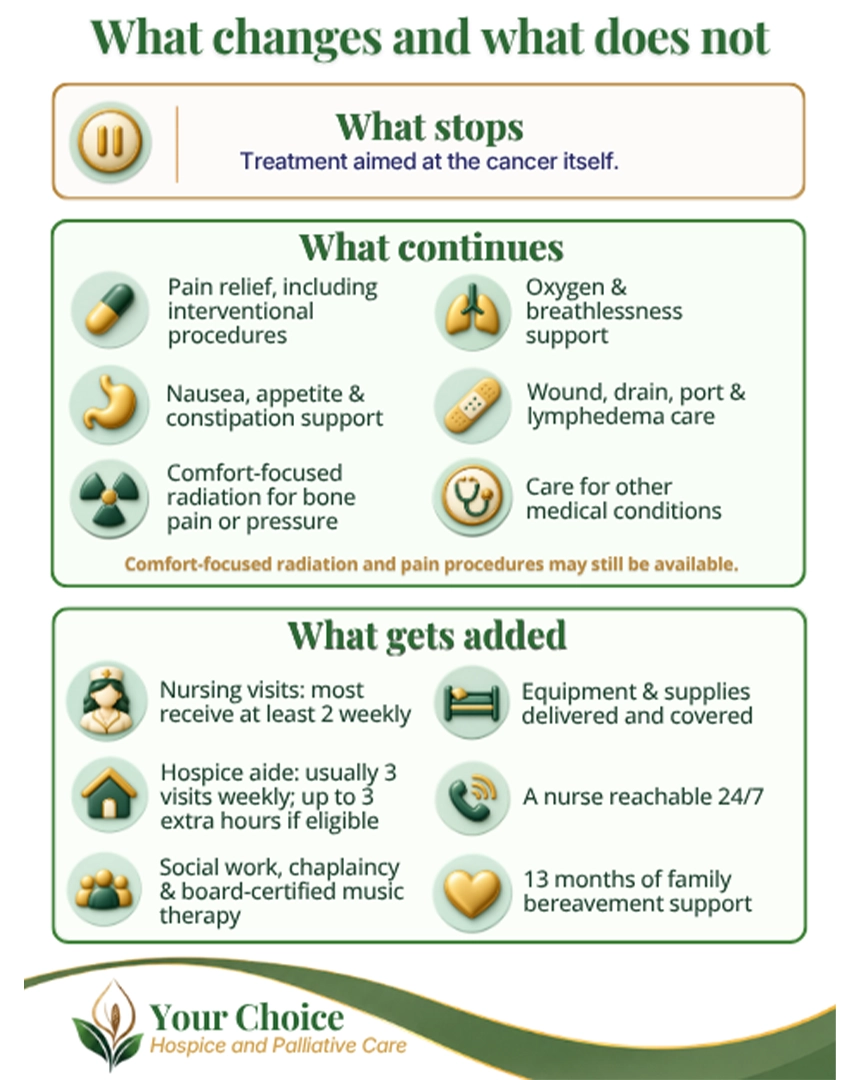
What changes, and what does not
What stops: treatment aimed at the cancer itself.
What does not stop — and usually intensifies:
- Pain management, including the interventional options when they are needed
- Anti-nausea medication, appetite support, treatment for constipation
- Radiation when its purpose is comfort — for bone pain, or a tumor pressing on something
- Oxygen, breathing support, medication for breathlessness
- Wound care, drain and port care, lymphedema management
- Everything for every other condition the person lives with
Families are often surprised that palliative radiation and interventional pain procedures remain available. They do, when the goal is comfort rather than cure.
What gets added: a team in the home. Nursing visits — at Your Choice most patients receive at least two a week. A hospice aide for bathing and daily care, usually three visits a week, with up to three additional hours weekly for those who qualify. Social work. Chaplaincy. A board-certified music therapist. Equipment and supplies delivered and covered. A nurse reachable at 2 a.m. And thirteen months of bereavement support for the family afterward.
The signs oncology families notice
The general nine signs apply. A few show up specifically in advanced cancer:
- Performance status dropping. More than half the waking day spent in a bed or chair is a meaningful threshold clinically.
- Recovery between cycles taking longer than the good stretch. When the window of feeling decent is shorter than the window of feeling wrecked, the arithmetic has changed.
- Weight coming off despite eating. Cancer cachexia is not simple appetite loss, and it does not reverse with more calories.
- Pain that needs escalation faster than it used to.
- New sites on a scan after a line of treatment that was supposed to hold.
- Hospital admissions for symptom control rather than for treatment itself.
- The patient saying something. I’m tired. I don’t want to do this again. Said quietly, once, often to whoever is not in charge. Take it seriously the first time.
The conversation with your oncologist
Oncologists rarely raise hospice first. Many are trying not to sound like they are giving up on someone they have treated for years.
Questions that open the door without forcing anything:
- “What are we hoping this next line will do — shrink it, hold it, or help how he feels?” • “What’s the realistic response rate for someone in his situation?”
- “If this doesn’t work, what would you recommend then?”
- “Would you be surprised if she were still with us in a year?”
- “Can we get a palliative care consult now, while we keep going?”
That last one is the most useful question in this article. It costs nothing, changes nothing about the treatment plan, and puts a symptom specialist on the team months before anyone needs to decide anything.
What about a clinical trial?
Enrolling in hospice and enrolling in a trial of disease-directed treatment are generally not compatible at the same time, because hospice replaces treatment aimed at curing the terminal illness.
But the sequence matters more than the rule. If a trial is genuinely available and your loved one wants it, take it — and ask for a palliative care consult to run alongside it, which is fully compatible and will make the trial more tolerable. If the trial ends or the person decides against continuing, hospice is there, and enrolling later is routine.
It is worth asking the trial coordinator one blunt question: is this trial designed to help him live longer, feel better, or answer a research question? All three are legitimate. They are not the same thing, and the answer should inform the decision.
Can we keep seeing our oncologist?
Usually, yes, and many families do.
Your loved one’s oncologist can remain involved and can serve as the attending physician on hospice if they are willing. What changes is the purpose of the visits — symptom management and continuity rather than treatment decisions.
For many families this matters enormously. After two years of a relationship with a cancer team, being handed to strangers feels like a second loss. Say at the evaluation that you want your oncologist to stay involved, and it can usually be arranged.
“We’re not giving up on her”
You are not.
Choosing comfort when treatment has stopped working is not abandoning someone. It is a decision about how to fight — for the nausea, for the pain, for the mornings clear enough to talk, for time at home instead of in an infusion chair.
And it is reversible. If a clinical trial opens, if a new option appears, if the family changes its mind — you may leave hospice at any time and return later. It is always your choice.
For oncology partners
When curative treatment is no longer the path, hospice is not the end of care. It is the beginning of a different kind.
Earlier referral in oncology is associated with better symptom control, fewer crisis admissions, less aggressive care in the final month, and measurably better bereavement outcomes for families. Our admissions team responds the same day, seven days a week, and we coordinate directly with your cancer center’s social workers and nurse navigators.
Same-day evaluations, seven days a week.
English: 877-732-2344 · Español: 844-447-2992